Verify a bundle
logbook verify rechecks a submission on your computer. It checks each device’s signatures and evidence chain, every proof, and the replay of every minute, then recomputes the capped seconds. It prints the same counts as the review page. It uses only the public pkg/ code the server runs, and no network.
You need an admin key to download the bundle, and the submission’s id (how to find it).
Get the logbook binary
Section titled “Get the logbook binary”verify is part of the normal Logbook agent from v0.2.0. If you already have the agent installed, skip this. Otherwise download the binary on its own; you don’t need to install or sign in.
In PowerShell:
Invoke-WebRequest https://github.com/apneduniya/logbook/releases/download/v0.2.0/logbook_windows_amd64.exe -OutFile logbook.exeInvoke-WebRequest https://github.com/apneduniya/logbook/releases/download/v0.2.0/checksums.txt -OutFile checksums.txt(Get-FileHash logbook.exe -Algorithm SHA256).Hash.ToLower()Select-String logbook_windows_amd64.exe checksums.txtThe two hashes must match. Use logbook_windows_arm64.exe on an ARM PC. Run it as .\logbook.exe.
curl -fsSL -o logbook https://github.com/apneduniya/logbook/releases/download/v0.2.0/logbook_darwin_arm64curl -fsSLO https://github.com/apneduniya/logbook/releases/download/v0.2.0/checksums.txtshasum -a 256 logbook && grep darwin_arm64 checksums.txtchmod +x logbookThe two hashes must match. Use logbook_darwin_amd64 on an Intel Mac. Run it as ./logbook.
curl -fsSL -o logbook https://github.com/apneduniya/logbook/releases/download/v0.2.0/logbook_linux_amd64curl -fsSLO https://github.com/apneduniya/logbook/releases/download/v0.2.0/checksums.txtsha256sum logbook && grep linux_amd64 checksums.txtchmod +x logbookThe two hashes must match. Use logbook_linux_arm64 on ARM. Run it as ./logbook.
To avoid trusting our release builds too, build it from the tagged source (Go 1.27.4 or later):
git clone https://github.com/apneduniya/logbook && cd logbookgit checkout v0.2.0go build -o logbook ./cmd/logbookCheck a submission
Section titled “Check a submission”-
Download the bundle. Replace
<submission-id>:Terminal window curl -fSL -o bundle.json.gz \-H "Authorization: Bearer $LOGBOOK_ADMIN_KEY" \https://api.logbook.boogles.dev/api/admin/v1/submissions/<submission-id>/bundleOn Windows, put the command on one line and use
curl.exeand$env:LOGBOOK_ADMIN_KEY.410means the raw evidence was deleted (withdrawn, or past retention).503means 4 exports are already running; wait a minute. -
Get a key fingerprint for each device from outside our server. The coder runs
logbook statuson each device and reads you theKey:line, a 16-character hex fingerprint. They can also read it under Devices on their Settings page, but that page is served by Logbook.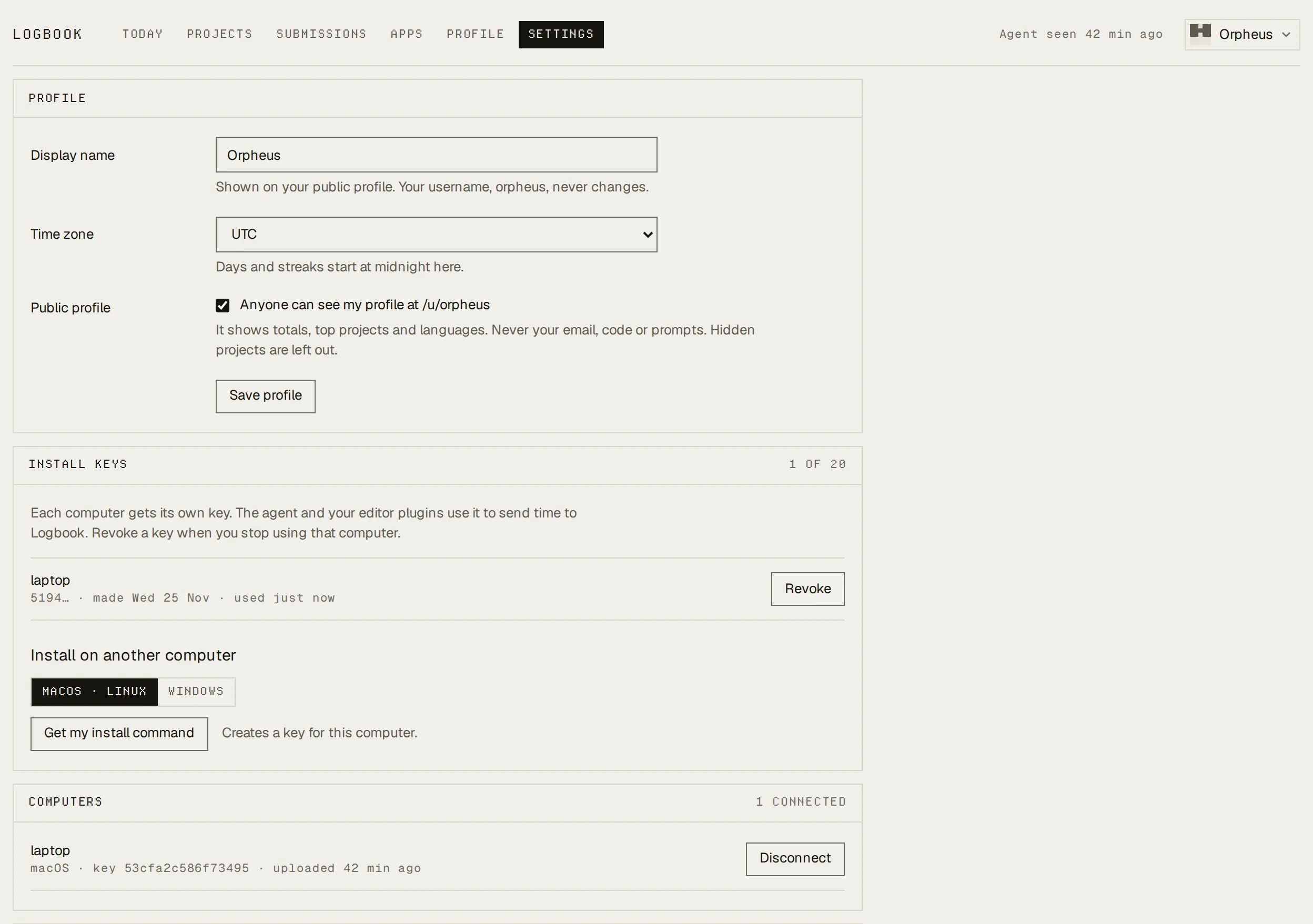
-
Run the check with every fingerprint:
Terminal window ./logbook verify --key 9c41d07be2a35f18 bundle.json.gzRepeat
--keyonce per device. The file can be gzipped or plain JSON. On Windows, run.\logbook.exe verifyinstead.
How to tell it worked
Section titled “How to tell it worked”verify exits with 0 when every check passes and non-zero when any fails. The last line says which:
Submission 0b7e2c1a-5d4f-4e8b-9a61-2f3c8d9e7a10: weather-bot, 2026-11-01 to 2026-11-20 (created 2026-11-21T09:14:03Z)Device laptop (6a1f0c3e-8b2d-4f71-a5c9-1e7d3b4f9c22) key OK 9c41d07be2a35f18, one of the fingerprints given signatures and chain OK 20 signed records proofs and replays OK 18 blocks, 744 minutes listedCap OK 744 capped minutes recomputed from 761 cap inputsMinutes 744 verified, 0 mismatch, 0 unbackedCounted 12.4 h (44,640 s), from the frozen capped secondsResult OK: every key, signature, chain, proof, replay and the cap check outCompare Minutes and Counted with the review page. They should be the same.
Without --key, each key line says not checked and the result adds that the bundle names its own keys. That run proves the bundle is consistent, but not that it came from the coder’s real devices.
What verification proves
Section titled “What verification proves”For every verified minute:
- Each device’s daily evidence records are signed by that device’s key and form one unbroken chain.
- The raw rows the bundle reveals are exactly the rows under the signed daily root. Salted buckets in a Merkle tree make this checkable without revealing the rest of the day.
- The 2-hour window the minute’s run read is complete: no row in it was left out.
- Running the stated rules version on those rows gives the same label, project, credit and cuts the device reported.
- The counted seconds are the cap rule recomputed from the frozen inputs, and the project’s credit comes only from frozen rows.
With --key from the coder’s own devices, a server can’t swap in records signed with a key of its own.
What it doesn’t prove
Section titled “What it doesn’t prove”- That the agent told the truth. A modified agent can invent activity in real time and sign it. That is an accepted risk: Logbook makes it detectable through flags, gaps and review, not impossible.
- When a record was signed. The bundle doesn’t carry upload times. That each day was sealed on that day rests on the server, which refuses a different record for a day it already stores. Those refusals are listed in
user/devicesasrefused_uploads. - Flags. Replays compare label, project, credit and cuts. Flags such as
low_signalare advisory and not rechecked. Claude Code active-time rows, which only feed theotel_mismatchflag, aren’t proven complete. - Minutes from other projects in the cap. The cap inputs from other projects are taken as frozen.
verifychecks the submitted project’s inputs against its frozen rows, not that no other project’s row was left out. - Unbacked minutes, by definition.
The reviewer guide explains how these show up on the review page: Evidence and trust.